In over 40 years of commercial diving and salvage experience, the most dangerous mistakes are rarely made by careless divers. They’re made by experienced, professional-looking divers who skipped one step.
This is the story of the closed valve — and why a complete pre-dive checklist isn’t optional.
Most Skipped?
Picture a diver who is fully geared up, looking sharp, performing their final checks on the surface. Everything looks right. The SPG needle doesn’t move when they take a breath, so they assume they’re good. They enter the water.
At depth, the increased ambient pressure demands a higher volume of air per breath. The tank valve — only partially open — can’t supply enough flow. The diver suddenly feels like they’re breathing through a clogged straw, or has run out of air entirely, despite the gauge still showing pressure.
The tank was never fully open. Someone “helped” by turning the valve all the way open and then back a quarter-turn — a legacy habit meant to protect the valve — and the diver assumed it was fully on.
This is one of the most preventable emergencies in diving. It is also one of the most common.
The #1 Most Skipped Item on the Buddy Check
Most divers remember to check their air. What gets glossed over — or skipped entirely — is the Low-Pressure (LP) Inflator hose and the BCD’s exhaust valves.
Here’s why this matters more than people realize:
Runaway Ascent
If the power inflator button sticks in the open position — from salt crystallization, sand, or a worn o-ring — the BCD inflates continuously. A diver who doesn’t immediately disconnect the hose or activate the dump valves faces a rapid, uncontrolled ascent. The consequences are decompression sickness or arterial gas embolism. Both are life-altering. Both are preventable with a 10-second check on the surface.
Negative Buoyancy at Depth
Conversely, an LP hose that isn’t properly connected means the diver has no ability to add air to their BCD underwater. They enter the water and immediately realize they can’t establish neutral buoyancy — or worse, can’t make a safe ascent without ditching weight.
Neither scenario announces itself on the surface. Both are caught — or not caught — during the buddy check.
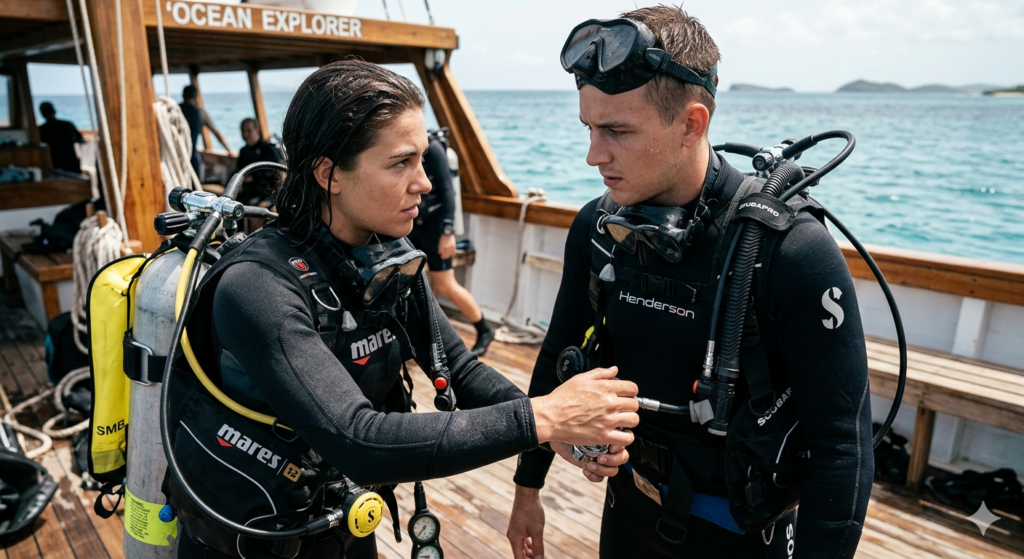
BWRAF: The Buddy Check That Saves Dives
BWRAF is the standard pre-dive buddy check taught in every open water certification. In practice, it gets rushed, abbreviated, or skipped entirely when divers are comfortable with each other. That’s exactly when it matters most — because familiarity breeds complacency.
- B — BCD: Inflates and deflates correctly. Holds air. All dump valves functional. LP inflator hose connected and moving freely — not sticky, not stiff.
- W — Weights: Correct amount for this diver, this wetsuit, this tank. Properly positioned. Quick-release accessible and demonstrated to your buddy.
- R — Releases: All buckles and releases checked, accessible, and operable with one hand. Your buddy knows where they are.
- A — Air: Tank valve fully open. SPG checked at depth — not just a glance. Both primary and secondary regulators breathing freely. Nitrox mix analyzed and MOD confirmed if diving enriched air.
- F — Final: Mask, fins, computer, surface marker buoy, dive light if needed. Dive plan confirmed. Depths, bottom time, turn pressure, and emergency procedures agreed on by both divers.
The Professional Standard: A Digitized Checklist
On remote projects, liveaboards, and multi-dive days — where fatigue compounds and complacency sets in — a rigid, standardized checklist is the difference between a professional operation and a dangerous one.
The reason to digitize it isn’t convenience. It’s accountability. A printed or digital checklist forces each item to be confirmed explicitly, not assumed. It removes the human tendency to mentally check off items that haven’t actually been verified.
The pre-dive workflow used on professional operations follows three principles:
- Gas management first: Verify mix, analyze oxygen content, confirm MOD and ppO₂ before gear goes on. This is not a step to do while suiting up.
- The Rule of Three: Validate your dive plan against multiple standards — PADI RDP, Navy Tables, and Navy Deco for technical dives. A plan that checks out on all three is a plan you can execute with confidence.
- Standardized checklist, every dive: Not when it feels necessary. Every dive. The dives where it feels unnecessary are statistically the ones where something gets missed.
What the Checklist Actually Covers
DepthPlanner’s built-in Pre-Dive Equipment Checklist covers 21 items across the full pre-dive sequence — not just BWRAF, but the complete workflow from cylinder analysis to surface signaling devices:
- Cylinder valve — fully open, verified at depth on SPG
- Oxygen analysis — actual percentage recorded, not assumed
- MOD calculated and confirmed for Nitrox dives
- BCD inflates, deflates, holds air — LP hose connected and free
- All dump valves functional
- Primary and secondary regulators breathing freely
- Weight system — amount correct, ditchable, buddy knows the release
- All buckles and releases accessible
- Dive computer — on, set correctly for gas mix, battery level confirmed
- Surface Marker Buoy (SMB) attached and deployable
- Mask, fins, wetsuit, gloves — all accounted for before the boat leaves the dock
- Dive plan confirmed with buddy — depth, bottom time, turn pressure, emergency procedures
And at the end — Print Plan generates a formatted dive summary you can leave on the boat. If something goes wrong underwater, the people on the surface know your planned depth, bottom time, gas supply, and emergency contact.
The Checklist Isn’t Bureaucracy. It’s the Standard.
Commercial aviation has a pre-flight checklist. Surgical teams have a pre-incision timeout. Emergency responders have a scene size-up protocol. These exist not because professionals are careless — but because even experienced professionals make mistakes under pressure, fatigue, and time constraints.
Diving is no different. The diver who skips the buddy check because they’ve done it a thousand times is the diver most likely to miss the closed valve, the stuck inflator, or the disconnected LP hose.
Do the check. Every dive. It takes 60 seconds and it has saved lives.
Open the free PADI RDP Planner — checklist included, no account required →
Try Free Now → Get Offline Access — $29.95
Scott Fontecchio is a PADI and SSI Master Scuba Instructor and commercial diver with over 40 years of diving and salvage experience, including deep water operations at Lake Tahoe. He is the founder of DiveRobotix LLC and the author of Mastering Buoyancy, a #2 Amazon new release in scuba diving books. DepthPlanner’s pre-dive checklist is built from real commercial diving protocols — not a generic recreational template.