DiveCommand

DiveCommand · Recreational & Technical Dive Planning · DiveRobotix LLC · depthplanner.com
No Install · No Account · Works Offline · Matches Your Dive Computer

Plan Your Dive in
Two Minutes.
On Any Device.

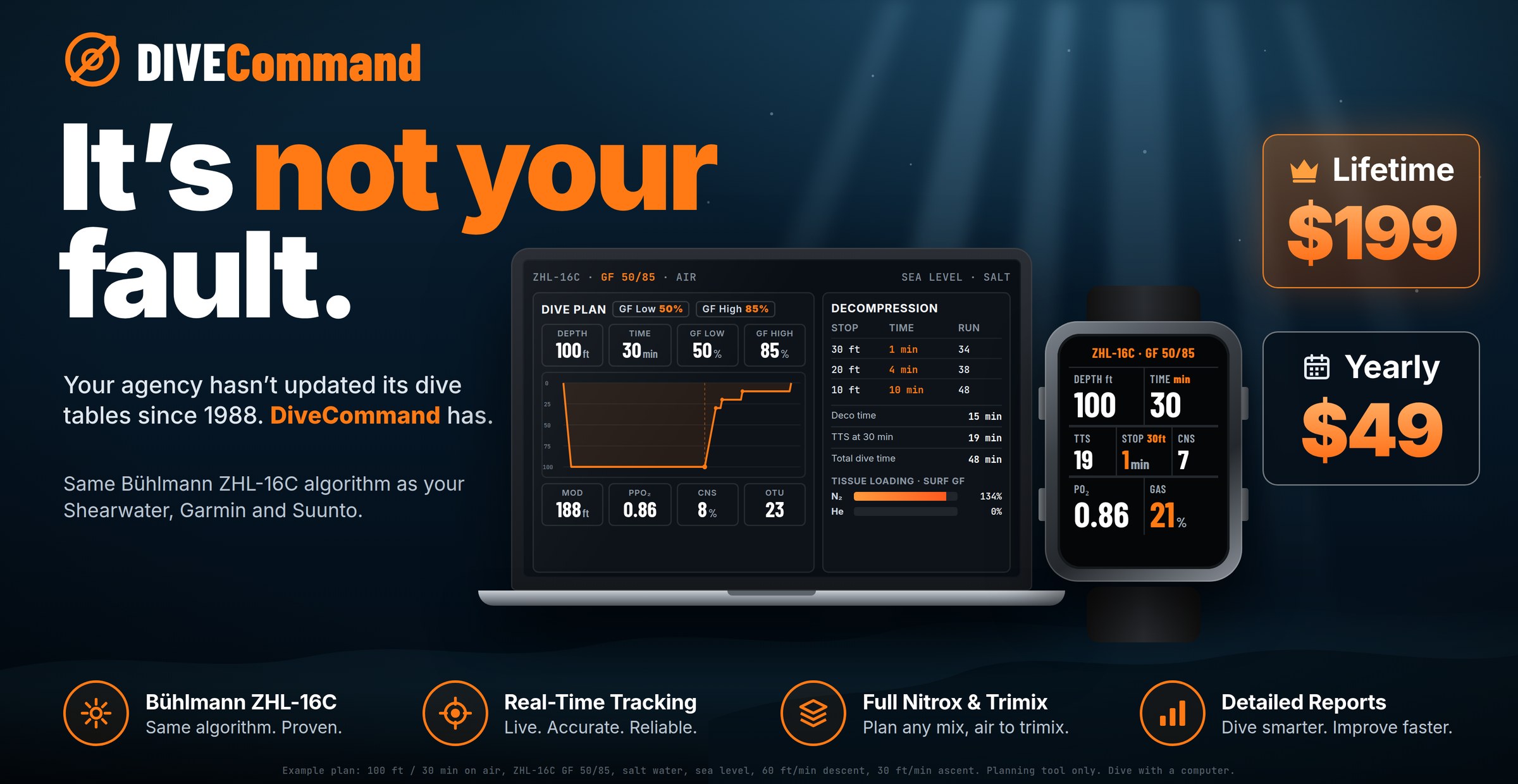
DiveCommand is the dive planner you’ll actually use before every dive — fast, browser-based, works offline, and runs the exact same Bühlmann ZHL-16C algorithm as your Shearwater, Garmin, and Suunto. No install. No account. No excuses.

Δ=0
Your planner and your wrist computer finally agree. DiveCommand uses GF 40/85 — the exact factory defaults on Shearwater, Garmin, and Suunto. Verified across 12,067 independent tests. Zero discrepancies.
✓ Bühlmann ZHL-16C · GF 40/85 ✓ 16-Compartment Live Tissue Tracking ✓ Δ=0 vs Shearwater · Garmin · Suunto ✓ Trimix to 330ft · EAD · END · ENP ✓ Altitude Corrections Built In ✓ 12,067 Validated Tests · Zero Failures ✓ Browser-Based · Works Offline · Any Device ✓ Interactive AI Planning Assistant Included
$49/yr · cancel anytime   ·   or buy lifetime for $149 · all future updates included   ·   30-day money-back guarantee
12,067
Validated Tests
100%
Pass Rate
16
ZHL Compartments
Δ=0
vs Shearwater
GF 40/85
Factory Default
330ft
Max Depth
AI
Built-In Assistant
Why DiveCommand Exists

Three Problems. One Tool.

Most dive planning software has at least one of these problems. DiveCommand was built specifically to solve all three.

2 min
The Planner You’ll Actually Use

The best dive plan is the one that happens. Open a browser, pick depth and gas, read your NDL — that’s the whole workflow. No install, no account, no app to update. Fast enough that skipping it stops making sense. Works on your phone at the dive site, laptop at home, tablet on the boat.

Δ=0
No More “Why Do the Numbers Differ?”

If your planner and your dive computer give different NDLs, one of them is wrong. DiveCommand uses the exact ZHL-16C at GF 40/85 — the same values Shearwater, Garmin, and Suunto ship with. Verified across 12,067 tests. The numbers match because the math is identical.

Live
Change Anything. See Everything Update.

Swap gas — NDL extends, ppO₂ updates, MOD recalculates. Adjust GF Low — tissue ceilings shift. Change depth — all 16 compartments respond. Every variable is live. No recalculate button. Plan the dive interactively, not by filling out a static form.

● ZHL-16C Active · GF 40/85
Breathing Gas
21%Air
32%EAN32
36%EAN36
21/35Trimix
Select Depth
35′180m
50′80m
80′17m
100′12m
130′7m
more
NDL Remaining
17 min
ppO₂ @ 80ft
0.592
CNS O₂
8.4%
GF40
GF Low
GF85
GF High
Δ=0
vs Shearwater
12,067
Tests
N₂ Tissue Load — 16 Compartments
5min
65%
8min
57%
12.5m
48%
18.5m
39%
27min
30%
38.3m
22%
54.3m
16%
77min
11%
Pick a depth. Pick a gas. Get your NDL.

Planning That Takes
Two Minutes, Not Twenty.

Select depth and gas. DiveCommand immediately returns your NDL, ppO₂, and CNS O₂ — calculated across all 16 Bühlmann ZHL-16C tissue compartments simultaneously. The tissue bars update as you change any input. No waiting. No recalculate button. Just answers.

Adjust gradient factors and watch ceilings shift. Switch from air to EAN32 and see the NDL extend. Move to trimix — EAD, END, ENP, and Z-factor real gas values recalculate instantly. Every variable is live. Change anything, read the result, and go dive.

The Δ=0 badge is the result of a Python reference implementation written from scratch and tested against the JavaScript engine at every depth and gas combination. 12,067 independent tests. Zero failures. So when your NDL matches your Shearwater, it’s not a coincidence — it’s the math.

Algorithm Verification

If Your Computer Runs It, DiveCommand Matches It

Bühlmann ZHL-16C at GF 40/85 is the factory default on every major dive computer. DiveCommand uses the same constants, compartment half-times, and gradient factor implementation.

🟦Shearwater Perdix / TericΔ=0
🟥Garmin Descent Mk3 / G1Δ=0
🟩Suunto D5 / EON SteelΔ=0

Δ=0 means zero deviation in NDL and decompression ceiling at factory default GF settings. Verified using an independent Python implementation with a completely separate codebase — not self-comparison. The validation harness is a public self-contained HTML file. Open it and run the tests yourself.

Altitude Integration

Altitude Corrections.
One Tap.

Diving at elevation — a mountain lake, a high-altitude reservoir, anywhere above sea level — changes every calculation you make. Reduced atmospheric pressure lowers M-values in every tissue compartment, which shortens NDLs. Same depth, same gas, shorter no-stop time. Anyone planning without altitude correction is working from optimistic numbers.

DiveCommand handles it automatically. Set your elevation and every NDL, ppO₂, and decompression obligation recalculates instantly — no conversion tables, no manual offset. The correction is built into the core ZHL-16C calculation, not a post-processing adjustment.

Covers sea level through 11,000ft with common elevation presets. If you dive in the mountains, it just works.

11,000
Max Altitude
Correction (ft)
Auto
NDL Correction
On Elevation Select
ZHL-16C
Core Calc — Not
a Lookup Table
1-Tap
Common Elevation
Presets Built In
Full Feature Breakdown

From First Reef Dive to 330ft Trimix Profile

The same validated engine scales from a single recreational no-stop dive to a multi-gas technical decompression profile.

🧬
16-Compartment ZHL-16C Engine

All 16 Bühlmann tissue compartments running simultaneously — 5-minute fast tissues through 635-minute slow tissues. GF 40/85 factory defaults match Shearwater, Garmin, and Suunto exactly. Adjust GF Low and GF High independently. Tissue bars update in real time as you change any parameter.

✓ Δ=0 · ZHL-16C · GF 40/85
⚗️
Advanced Trimix Suite — 330ft

Full technical gas planning to 330 feet. EAD, END, ENP, and Z-factor real gas corrections for high-pressure helium mixtures. Custom GF presets for different profile types. Three-bottle stage/deco gas management with rock bottom calculator.

✓ Trimix · EAD · END · ENP · Z-factor
⛰️
Altitude Corrections Built In

Sea level through 11,000ft with common elevation presets. Every NDL, ppO₂, EAD, END, and deco ceiling recalculates instantly on elevation change. Integrated into the core ZHL-16C calculation — not a post-processing table — so every tissue compartment reflects the correct ambient pressure.

✓ Auto-Corrected · Sea Level to 11,000ft
📊
Live Safety Metrics

Toggle gas and watch ppO₂, MOD, CNS O₂, and tissue loading update simultaneously. ppO₂ hard limit enforcement at 1.4 and 1.6 ata. CNS clock tracks cumulative oxygen toxicity. Visual warnings before any limit is approached.

✓ ppO₂ · MOD · CNS O₂ · Live
📓
Integrated Dive Logbook

Log every dive with site, buddy, depth, bottom time, gas, temp, and visibility. SAC rate tracking across dives and conditions. Plan vs actual comparison. CSV export for records or training review.

✓ SAC Rate · Plan vs Actual · CSV
🔁
Multi-Day N₂ Carry-Over

Liveaboard expedition planning. Tissue loading carries forward from dive to dive across multiple days. The tissue state at the end of Day 2 Dive 4 is the starting point for Day 3 Dive 1. No manual resetting — the model tracks your actual nitrogen load continuously.

✓ Multi-Day · Expedition Planning
🖨️
Print-Ready Dive Plans

Clean print-ready plan showing profile, NDLs, gas switches, CNS budget, and deco schedule. SVG dive profile visualization with tissue compartment loading overlay. Fully self-contained — no internet needed to view a printed plan.

✓ SVG Profile · Print-Ready
💧
Freshwater / Saltwater Toggle

Freshwater is less dense — 33ft seawater equals 34ft freshwater at the same pressure. Different ATA, different ppO₂, different EAD, slightly different tissue loading. DiveCommand corrects all of it automatically. Verified across all 11 test depths.

✓ SW / FW Density Corrected
DIVEAI Instructor · Online
AI
Ask me anything about your dive plan — NDL calculations, tissue loading, altitude corrections, ppO₂ limits, gradient factors, or why your planner and wrist computer sometimes show different numbers.
🤿
Why does my NDL change when I switch from air to EAN32?
AI
Because EAN32 has less nitrogen — 32% O₂ means only 68% N₂ vs 79% in air. Less nitrogen on-gasses into your tissues per minute of bottom time, so they take longer to reach the Bühlmann M-value limit for each compartment. That’s your NDL extending. The tradeoff: higher O₂ fraction means a lower MOD and a faster-rising CNS% — DiveCommand tracks both automatically when you switch gases.
🤿
What does GF 40/85 actually mean?
AI
GF Low (40) sets your first decompression stop depth — a more conservative first stop, deeper in the water column. GF High (85) controls your final ascent ceiling at the surface stop. Lower numbers = more conservative, fewer supersaturation bubbles allowed. 40/85 is the Shearwater factory default, which is why DiveCommand matches it at Δ=0.
// try asking
What does N₂ load 90% mean? ppO₂ vs CNS% — the difference? Why use EAN32 over air? How do gradient factors work?
Ask a dive planning question…
ASK →
Powered by Claude · Internet required to ask · Your dive data stays offline
New — AI Dive Planning Assistant

Your Instructor.
Always Available.

DiveCommand includes an interactive AI dive planning assistant — tap the instructor button in the bottom corner of the planner and ask it anything. Why is my NDL shorter at altitude? What does 90% nitrogen load mean? How do gradient factors affect my ascent?

The assistant is trained on DiveCommand’s exact specs — Bühlmann ZHL-16C, the Δ=0 verification, GF 40/85 defaults, altitude corrections, and how every calculation works. It answers in plain language, like a knowledgeable instructor talking through a concept — not a manual entry.

Built on Claude by Anthropic. Your dive plans never leave the device. The assistant only needs internet to answer questions — not to run the planner.

💬
Plain Language
Decompression science without jargon
🧠
Knows the Algorithm
ZHL-16C, GF, altitude M-values, CNS, ppO₂
📵
Data Stays Offline
Your dive plans never touch the internet
Included Free
Built into DiveCommand — no extra charge
Try asking:
“Why is my NDL shorter at altitude?” · “What does N₂ load 90% mean?” · “How do GF Lo and GF Hi change my plan?” · “What’s the difference between ppO₂ and CNS%?” · “Why does my Shearwater show a different NDL?”
🔬

Validated by an Independent Reference Implementation

DiveCommand’s ZHL-16C engine was validated using a Python reference implementation written entirely from scratch — separate codebase, same Bühlmann 1990 constants, no shared code with the JavaScript engine. Both were tested across 12,067 cases spanning every depth, gas mix, and GF combination. Agreement at Δ=0 at every single case. The harness is a self-contained HTML file — open it in any browser and run all 12,067 tests yourself.

12,067
Tests
100%
Pass Rate
22
Harnesses
Δ=0
Delta
DiveCommand vs Generic Planners

What You Get When the Algorithm Is Exact

Most online dive planners use simplified formulas rather than the full Bühlmann model. Here’s the difference in practice.

DiveCommand vs Generic Web Planners — Algorithm Accuracy & Feature Matrix
Capability DiveCommand
$49/yr or $149 lifetime
Generic Planners
Free / Various
Full Bühlmann ZHL-16C — not an approximationApproximate
GF 40/85 factory default — matches wrist computers
Δ=0 verified vs Shearwater · Garmin · Suunto
All 16 tissue compartments tracked simultaneouslyRarely
Custom GF Low / GF High adjustmentSometimes
Trimix to 330ft · EAD · END · ENP · Z-factorRarely
Rock bottom gas calculator
3-bottle stage/deco gas management
Altitude corrections — sea level to 11,000ftRarely
Freshwater / saltwater density toggle
ppO₂ · MOD · CNS O₂ live trackingSome
SVG dive profile visualizationSome
Integrated logbook · SAC rate · plan vs actualSome
Multi-day nitrogen carry-over
CSV export for all logged divesRarely
100% offline · any device · no downloadVaries
Public validation harness (open-source test)
Interactive AI planning assistant
Lifetime license — no subscriptionFreemium
📶

Runs Offline. Works Anywhere.

Remote dive boat. Mountain lake. Liveaboard mid-ocean. DiveCommand installs once and runs completely offline — iOS, Android, Mac, Windows, tablet, or phone. Every tissue calculation, altitude correction, logbook entry, and printed plan works without a connection. A world-class decompression model that fits in your pocket and doesn’t need the internet to think. (The AI assistant is the only feature that requires internet — and only when you ask a question.)

Pricing

Own Your Software. Own Your Profile.

Buy it once, use it forever. No subscription, no version upgrades to purchase, no recurring charges when your credit card expires.

DIVECOMMAND
Recreational & Technical Dive Planning Software · Bühlmann ZHL-16C · Single User · Any Device
Annual
$49
Per Year · Cancel Anytime
Lifetime
$149
One-Time · All Updates
💡
Start at $49/yr — upgrade to lifetime anytime. Most divers who start annual switch to lifetime within 12 months once they’re using it before every dive. After 3 years the math is identical either way.
What’s Included
  • Full Bühlmann ZHL-16C engine — GF 40/85 factory default, not an approximation
  • Δ=0 verified against Shearwater, Garmin, and Suunto at factory GF settings
  • 16-compartment tissue tracking — live recalculation on every input change
  • Custom GF Low / GF High gradient factor adjustment
  • Technical mode: trimix to 330ft, EAD, END, ENP, Z-factor real gas
  • 3-bottle stage/deco gas management + rock bottom gas calculator
  • ppO₂ · MOD · CNS O₂ tracking with live safety thresholds
  • Altitude corrections — sea level to 11,000ft with common elevation presets
  • Freshwater / saltwater density toggle — physics-corrected
  • SVG dive profile visualization · print-ready dive plans
  • Integrated logbook — site, buddy, SAC rate, plan vs actual
  • Multi-day expedition nitrogen carry-over
  • CSV export · 100% offline · any device · no account required
  • Interactive AI dive planning assistant — included, no extra charge
  • All future updates included — no version upgrades to purchase
Subscribe — $49/yr · Cancel Anytime Try It Free First — No Account, No Install Required →
30-Day Money-Back Guarantee — No Questions Asked. Try DiveCommand free first. If you buy and the NDLs don’t match your dive computer at factory GF settings, or if it doesn’t become your go-to planning tool, email us and you get a full refund. Risk is zero.
Built By

Written by a Diver, Not a Developer Who Read About It

Scott Fontecchio is a PADI Master Scuba Diver Trainer and SSI Master Instructor with 40+ years of diving experience and 1,000+ dives. He built DiveCommand because he was tired of explaining to students why the planning software said one thing and their Shearwater said another — and tired of planning tools that required a desktop install and 20 minutes to produce a number he could have gotten in 30 seconds.

The Δ=0 verification isn’t a marketing claim — it’s the result of building a separate Python implementation from the same Bühlmann 1990 source, running 12,067 test cases, and confirming zero deviation at every single one. The math is the same because the same math was used.

The validation harness is public. Load it in a browser and run all the tests yourself. Then plan your last dive in DiveCommand and check the NDLs against your computer. That’s the whole pitch.

Two Minutes.
Any Device. Every Dive.

Open a browser, pick a depth and gas, get your NDL. No install, no account, no friction. When the numbers match your Shearwater, you’ll understand why this is the planner you’ll actually use.

✓ 30-Day Money-Back Guarantee    ✓ $49/yr · Cancel Anytime    ✓ Or Buy Lifetime — $149
✓ Any Device · Works Offline · No Account    ✓ Δ=0 vs Shearwater · Garmin · Suunto
Scroll to Top