The Twin Cave fatality report offers a sobering lesson for dive planning: an emergency gas-consumption rate can be far higher than a diver’s resting rate, or a simple “double your SAC” assumption suggests.
This article summarizes gas-planning lessons from the National Speleological Society–Cave Diving Section (NSS-CDS) Accident Analysis Committee report. It does not reconstruct the incident in detail or provide a dive plan. Cave diving requires formal training, established procedures, and team-specific planning.
What the report says about gas use
On 18 March 2025, a three-person team entered Twin Cave in Jackson County, Florida. The team used Optima rebreathers and DPVs. Trouble began at approximately 1,000–1,200 feet of penetration, near a low clay tunnel that silted out. The area was approximately 55 feet deep, or 2.6 ATA.
Computer downloads showed that the victim bailed out from the rebreather to open circuit 10 minutes into the dive. The NSS-CDS report estimated that the right bailout cylinder, the one used for breathing, went from 3,200 psi to empty in 10 minutes. It was a low-pressure 45 rated at 2,400 psi and contained approximately 60 cubic feet at the starting pressure.
The report used those figures to estimate an emergency SAC rate of approximately 2.3 cubic feet per minute. That is a surface-equivalent rate: it accounts for the surrounding pressure at depth.
The left bailout cylinder had dropped from 3,200 psi to 1,400 psi, apparently because its regulator free-flowed unnoticed on the way in. The diver died with that gas still available but did not switch to that cylinder. The autopsy identified drowning as the cause of death. The rebreather was evaluated as fully functional.
These details are not a formula for predicting every emergency. They show why a calm-water breathing rate, or a blanket multiplier, cannot be treated as a guaranteed upper limit.
The math: from pressure used to SAC
To estimate surface-equivalent gas consumption, use:
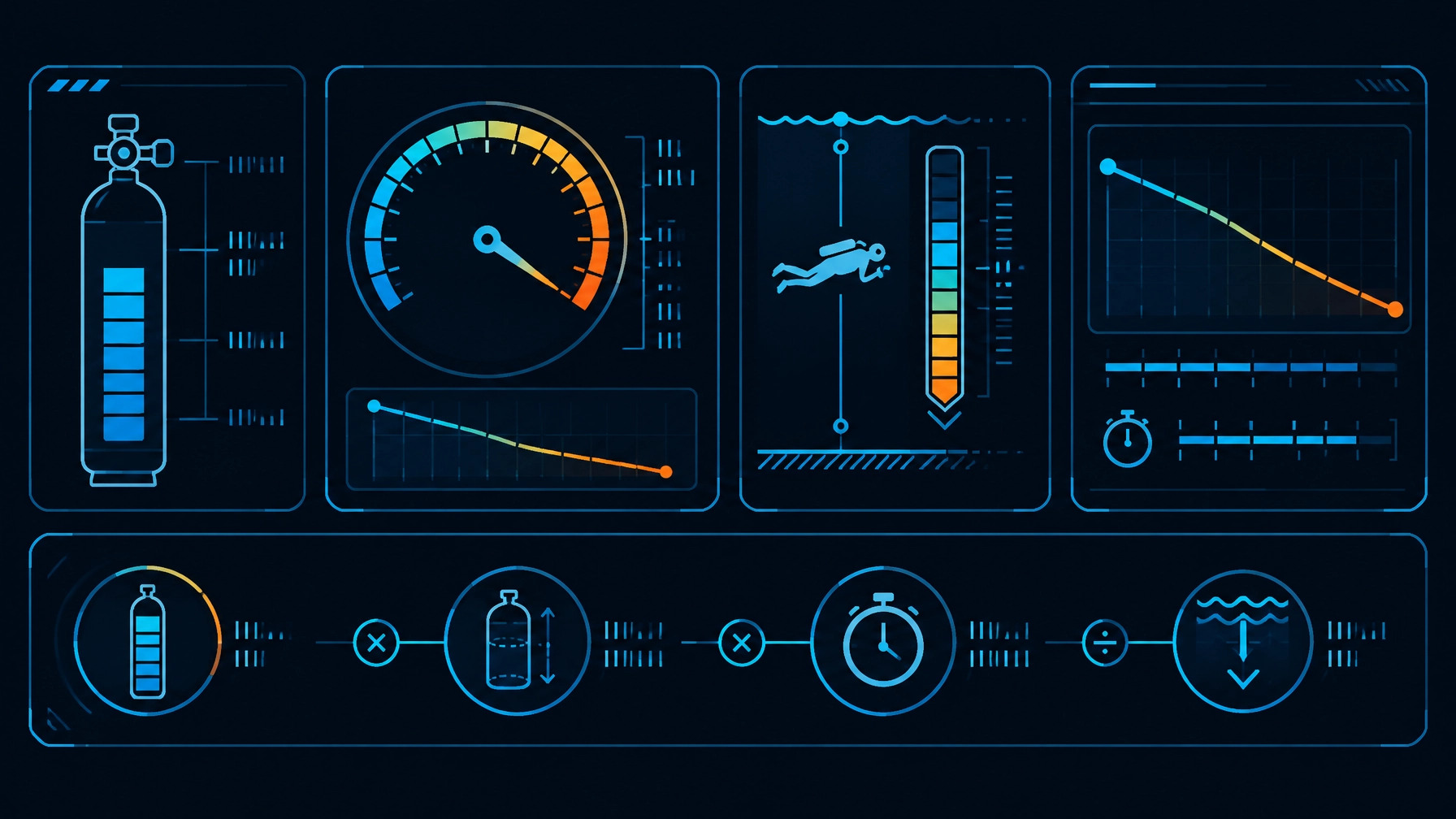
SAC ≈ gas consumed ÷ (time × ambient pressure in ATA)
Using the report’s estimates:
60 cu ft ÷ (10 min × 2.6 ATA) ≈ 2.3 cu ft/min
If you are working from pressure rather than a reported gas volume, first estimate gas consumed using the correct cylinder factor for that cylinder and its pressure change:
Estimated gas consumed ≈ pressure drop × cylinder factor
Then divide by time and ambient pressure:
SAC ≈ (pressure drop × cylinder factor) ÷ (time × ATA)
Use the cylinder manufacturer’s specifications and your team’s accepted method. Gas-volume estimates from pressure readings are approximate; the cylinder, fill, temperature, and measurement conditions matter. The report’s approximately 2.3 cu ft/min figure is also an estimate reconstructed from the stated gas use and depth, not a controlled measurement of breathing physiology.
Why “2× SAC” is not a safe ceiling
A common planning assumption is that a diver who normally consumes 0.5 cu ft/min might consume 1.0 cu ft/min under stress. The report specifically warns that the emergency rate is not known in advance. In this case, the estimated rate of 2.3 cu ft/min was about 4.6 times the report’s illustrative 0.5 cu ft/min baseline.
That comparison does not mean every diver will consume gas at this rate in an emergency. Nor does one accident establish a universal emergency rate. It does show that “twice normal” is a planning assumption, not a physical limit or proof that a reserve is adequate.
Workload, stress, equipment configuration, depth, and the problem a team must solve all affect gas needs. The practical question is not simply, “What is my normal SAC?” It is, “What gas would this team need to exit if the problem happens here, under the conditions we are planning for?”
Plan the exit requirement, not just a multiplier
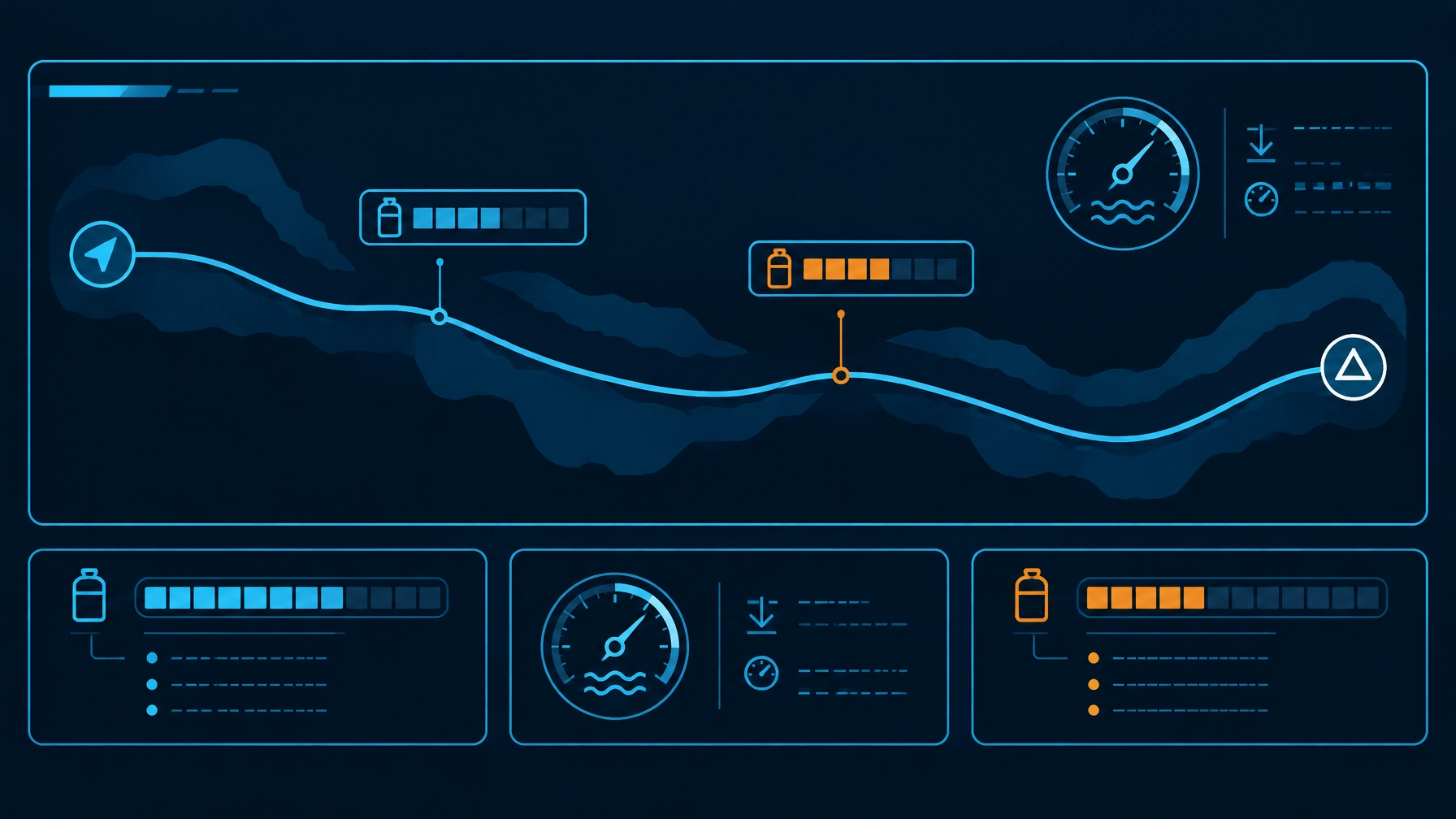
Rock-bottom gas planning is a way to establish the minimum gas needed to begin an exit under a defined emergency scenario. At its simplest, estimate the gas required for the planned exit:
Gas required = consumption rate × ATA × exit time
The scenario and assumptions have to be explicit. Account for the diver or divers who may need gas, the time and workload involved in exiting, and any team-specific contingency or reserve requirements. The remaining usable supply must cover that calculated need, with the safety margins established by the team’s training and procedures.
This is a planning principle, not a ready-to-use cave-diving calculation. The formula alone cannot tell you what emergency rate, exit time, team size, or reserve is appropriate for a particular dive. Those inputs must come from qualified instruction, the actual equipment and environment, and an agreed team plan.
Three practices the report brings into focus
1. Check for free-flowing regulators, including during DPV travel
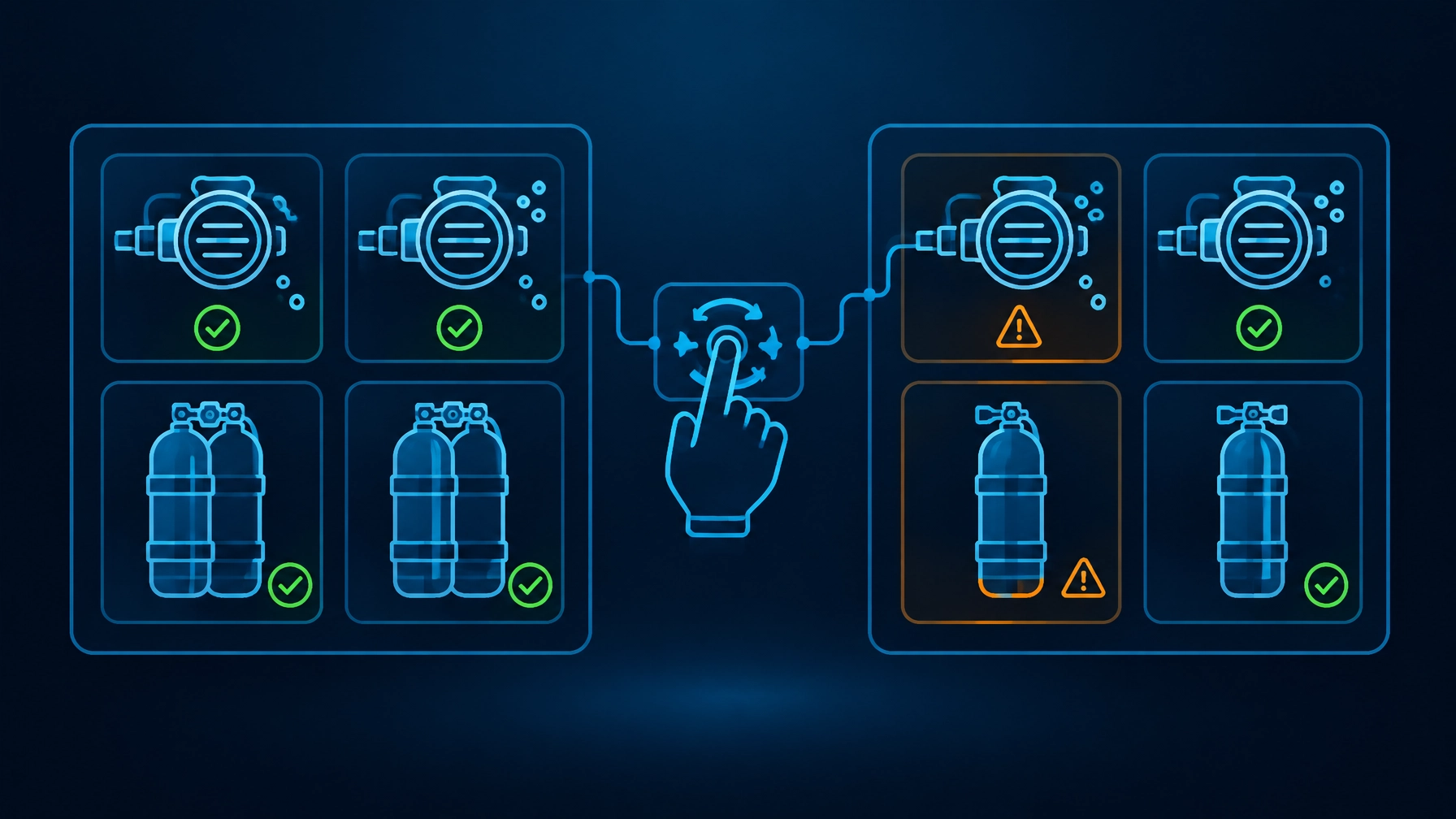
A regulator that is free-flowing can reduce a cylinder’s reserve without attracting attention, particularly while a diver is using a DPV. Include regulator function and cylinder pressure in pre-dive checks, and follow your training for monitoring gas during the dive. The report’s reconstruction indicates that the left cylinder lost pressure before the bailout began.
2. Rehearse switching to the second cylinder
The report notes that gas remained in the second cylinder, but the diver never switched to it. Gas carried is only useful if it can be accessed and breathed when needed.
Practise bailout and cylinder-switching procedures in appropriate training conditions. Rehearse identifying which cylinder is active, making the switch, and confirming gas flow. Practice should reflect the actual equipment configuration and team procedures.
3. Include rebreather decision-making in training
The NSS-CDS report notes that, with a functioning rebreather and unreadable PO₂ during a silt-out, going to semi-closed mode can significantly extend gas supply. That is a report-specific lesson, not a recommendation for readers to change rebreather mode outside their training and procedures. Rebreather decisions require appropriate training, equipment knowledge, and situational judgment.
Keep decompression planning and gas planning distinct
Decompression planning and breathing-gas planning are related, but they answer different questions. A decompression model can help plan a profile; it does not determine whether a team has enough bailout gas for a specific emergency exit.
DepthPlanner’s DiveCommand supports decompression dive planning with the Bühlmann ZHL-16C model and includes a rock-bottom calculator in its technical features. Its calculations do not replace a diver’s responsibility to plan gas, verify equipment, or follow formal training and team procedures.
For context on the other planning series on this site, see Navy Dive Tables 101: A Beginner’s Guide to Mastering US Navy Rev 7.
The practical takeaway
The Twin Cave report does not establish a universal emergency SAC rate. It does show why a 2× assumption should not be mistaken for a ceiling. Use conservative, scenario-based gas planning; account for the team’s actual exit problem; check for silent gas loss; and rehearse bailout switching until it is a practised skill.
For the incident facts and the NSS-CDS committee’s full analysis, read the original report.