The Devana Kandu tragedy is a reminder that a dive plan is only as sound as every decision behind it: training, authorization, environment, gas, team, and emergency response.
On 14 May 2026, five Italian divers died inside Devana Kandu, a submerged cave system off Alimatha island in the Maldives’ Vaavu Atoll. Their deaths were reported as the deadliest diving incident in Maldives history. Two days later, Maldives Coast Guard Sergeant First Class Mohamed Mahudhee died during the recovery operation.
The tragedy deserves careful attention, not a confident reconstruction of events that investigators had not resolved. A Maldives Independent report published on 11 June detailed what the recovery divers saw and what investigators were still seeking. A GoPro recovered from the cave was considered central to establishing what happened. The causes remained under investigation in Rome and Malé at the time of that report.
What can be discussed responsibly are the planning principles raised by the published facts, and the limits of what is known.
A permit is not a substitute for training
The cave entrance is about 55 metres (180 feet) deep. The group was found around 60 metres (200 feet) inside. The Maldives’ recreational diving limit is 30 metres; the divers’ permit allowed dives to 50 metres. That permit depth was already 20 metres beyond the recreational limit, yet still shallower than the reported depth inside the cave.
The government said it did not know that cave diving would be involved. That distinction matters: permission for a depth or activity described in a permit does not automatically authorize a different environment or hazard.
Depth, gas, equipment, and training must fit together. A permit cannot supply missing qualifications, and reaching a particular depth does not establish that a diver is prepared to manage it. When the planned depth or environment falls outside a diver’s training, the safe choice is to decline or change the plan, not to treat the permit as permission to proceed.
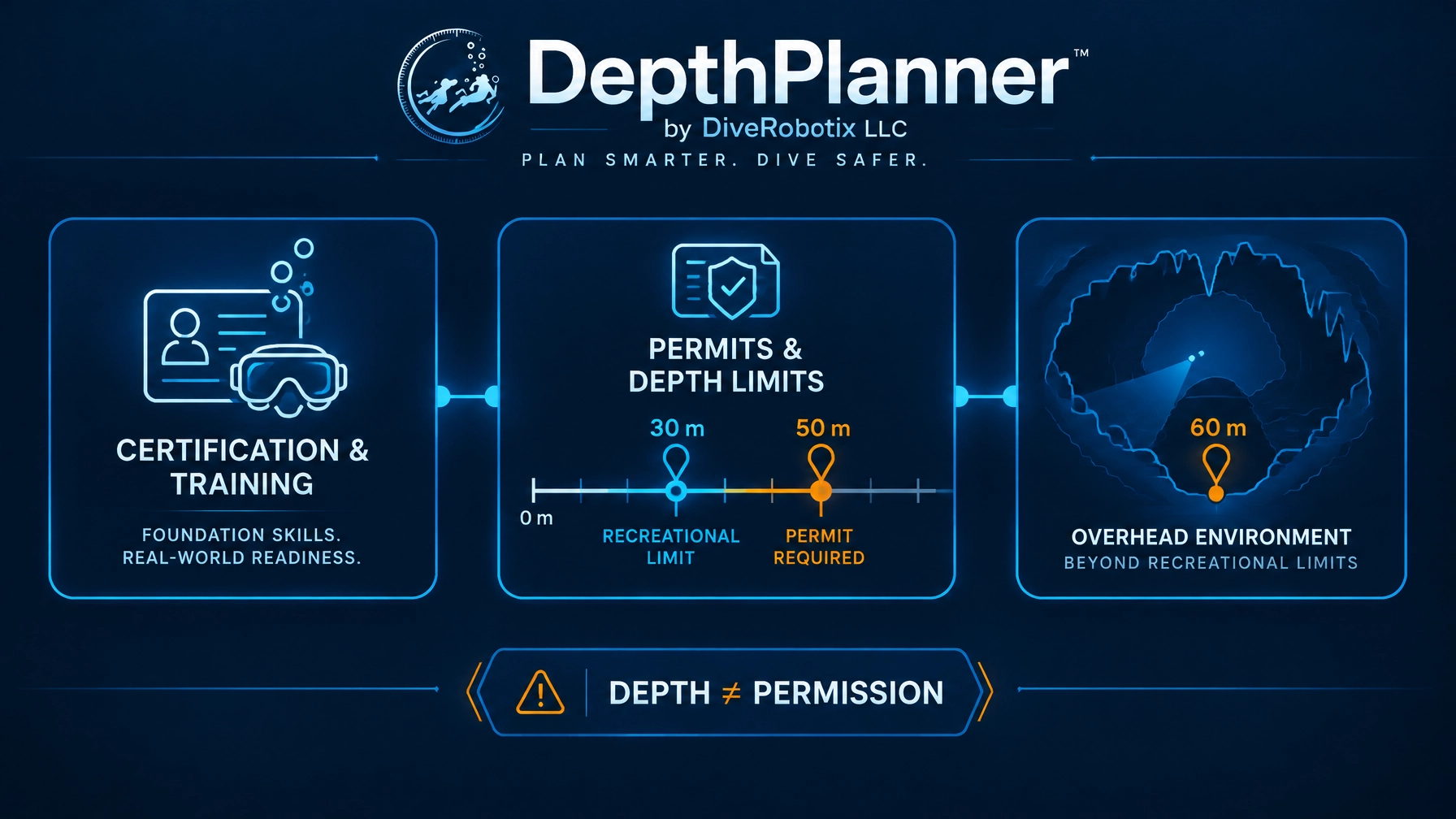
Depth, authorization, and environment are separate checks. One does not replace the others.
An overhead environment changes the exit problem
A cave is not simply a deep dive. In open water, a diver can ascend directly toward the surface. Inside an overhead environment, the route back matters. The recovery divers identified the failure to lay a guideline as the critical error. They said fin movement stirred up sediment, visibility was lost, and the exit became difficult to find. Four divers were found together in a dead-end side passage.
That account comes from the recovery team; it is not a final investigative finding about every decision made during the dive. But the general lesson is clear: overhead environments require formal cave-diving training and procedures. A visible entrance is not an invitation to enter.
Guidelines are a fundamental part of cave-diving safety because they provide a reference to the exit when visibility deteriorates. This is not a technique to learn from an article. Cave diving requires appropriate training, equipment, and supervised experience. If those are absent, do not enter.
Gas planning must include the way out
The recovery team reported that the divers used standard recreational compressed-air cylinders, described by one diver as “tourist tanks,” rather than technical equipment. At 60 metres, such a tank lasts tens of minutes, and gas is also needed for the ascent and any decompression obligation.
A bottom-time estimate alone is not a complete gas plan. A plan has to account for the entire dive, including the return and a reserve for problems. The deeper the dive, the more important it is to understand what the planned gas can support and what happens if the dive takes longer than expected. There is no responsible way to reconstruct an exact gas requirement from the public facts alone.
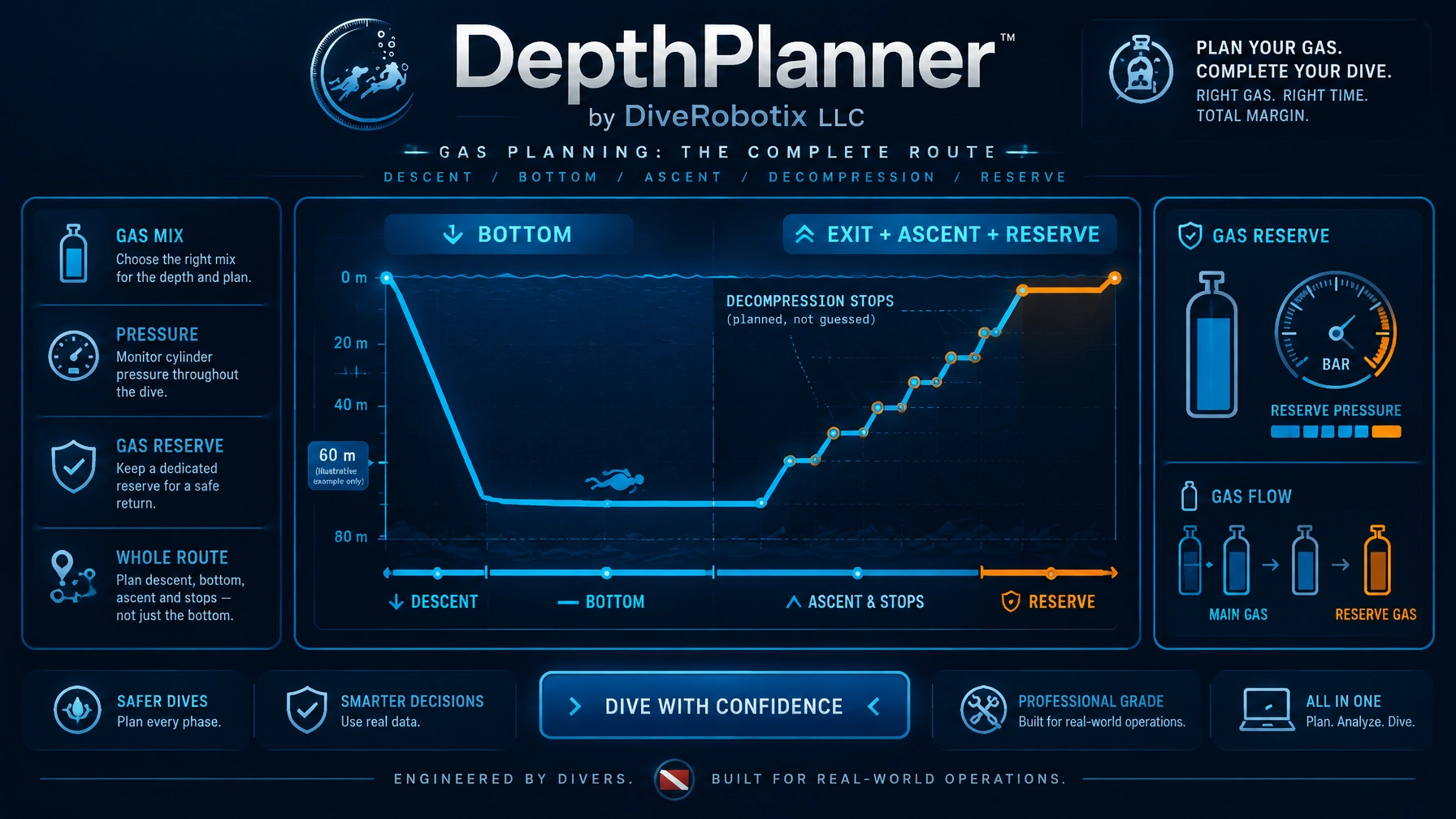
Plan for the full profile, not just the time spent at depth. This illustration is conceptual, not a dive plan.
Exposure protection and team decisions matter
Recovery divers reported that two members of the group wore only thin neoprene over swimwear. That fact does not establish what role exposure protection played in the deaths. It does underline that thermal protection should be considered as part of a deep-dive plan, even in warm water. Conditions, exposure time, depth, and individual needs all matter.
Planning also depends on whether a team can question or stop a dive. A briefing should make the intended depth, environment, equipment, and limits clear. Every diver should be able to raise a concern or opt out without pressure. Operators and permit systems should make it possible to verify that the actual activity matches what was authorized. None of this requires speculation about what the group discussed; it is a practical standard for safer operations.
Rescue must be planned, not improvised
Mahudhee died during the recovery effort. His family later disputed the recorded cause of death; hospital records showed he had no pulse when he surfaced. Those details deserve to be stated without trying to resolve a question that is still contested.
The loss of a rescuer is a reminder that emergency response is itself a high-risk operation. A rescue plan must consider the environment, the capabilities of the people entering it, and the resources required to support them. Sending personnel into a deep overhead environment without suitable specialist capability can create further danger. The initial emergency response and the later Finnish technical-diving operation reported by DAN Europe make clear why rescue capacity should be considered before an incident, not assembled under pressure afterward.
The Finnish team recovered the five Italian divers over four operational days between 18 and 21 May. Reuters and the Associated Press also reported on the recovery. The recovery divers said they located the four divers inside the cave with about five minutes of search time remaining before they would have had to surface. That narrow margin reflects the demands of the recovery mission; it should not be treated as a model for planning a dive.
Where decompression planning tools fit
Decompression dive planning can help divers examine a profile, gas choices, and decompression obligations within the scope of their training. It cannot determine whether a diver is qualified for a cave, confirm that a permit covers the actual activity, or replace a team’s procedures and judgment.
DiveCommand uses the Bühlmann ZHL-16C model for dive planning; its Pro features include technical planning and CNS/OTU tracking. The tool supports planning. It does not make an unsuitable dive safe. Use it alongside qualified instruction, your established procedures, and an appropriate dive computer. Do not use software as a substitute for training or as justification to exceed your limits.
This article is part of DepthPlanner’s dive-planning series, alongside Navy Dive Tables 101. Each topic has its own scope. Neither a table nor an algorithm can resolve a mismatch between training, authorization, equipment, and environment.
The practical lesson: check every link
Before a dive, ask whether the plan holds together from start to finish:
- Training: Does every diver have the qualifications and experience for this depth and environment?
- Authorization: Does the permit accurately describe the planned activity, not just a maximum depth?
- Environment: Is this open water, or does an overhead prevent a direct ascent?
- Gas and exposure: Does the plan account for the full dive, return, decompression if required, reserves, and thermal protection?
- Team and response: Can anyone stop the dive, and is an appropriate emergency response planned?
These checks do not explain exactly what happened at Devana Kandu. The recovered GoPro and ongoing investigations may add evidence; until then, conclusions about the causes should remain within the published facts.
Six people lost their lives: five divers inside the cave and Sergeant First Class Mohamed Mahudhee during the recovery operation. They should be remembered with respect. The investigations in Rome and Malé were still unresolved in the Maldives Independent’s June 2026 reporting.
Educational framing only, not a dive plan. Deep and cave diving require formal training, appropriate equipment, and qualified oversight.