California’s amended diving rules took effect January 1, 2026. That date has passed, so contractors still using pre-amendment procedures should treat this as an implementation review, not a future deadline.
The changes affect how supervisors verify diver readiness, how teams plan SCUBA operations, and how they document exceptions and support roles. They also keep a key scope point: commercial divers must meet the general diving requirements in Title 8, Article 152 (§§6050–6058), plus the commercial-diving requirements in Article 153 (§§6059–6063), which take precedence where both address the same situation.
This overview is based on the amended Cal/OSHA Title 8 text and the text approved by the Office of Administrative Law (OAL). Verify the official regulation and its application to your operation before relying on this summary.
Start with scope: commercial requirements still apply
Amended §6050 keeps a provision that has been in effect since 2023: any diver involved in commercial diving operations must also comply with Article 153 (§§6059–6063), which takes precedence where it and Article 152 (§§6050–6058) address the same situation. (§6062 within that range is repealed, so the live commercial provisions are §§6059–6061 and 6063.) The amendment does not replace those commercial-diving provisions with the general requirements in §§6050–6056.
The practical first step is to confirm which rules apply to each operation. California’s §6050 includes specific exclusions, including certain operations under U.S. Coast Guard jurisdiction. The federal standard, 29 CFR 1910 Subpart T, is a relevant reference, but it does not by itself resolve every question about jurisdiction or employer coverage.
Update: Review each job type, location, and diving mode against the actual scope and exceptions. Do not assume that one set of rules applies identically to every project.
1. Confirm your pre-dive check matches the DPIC duty
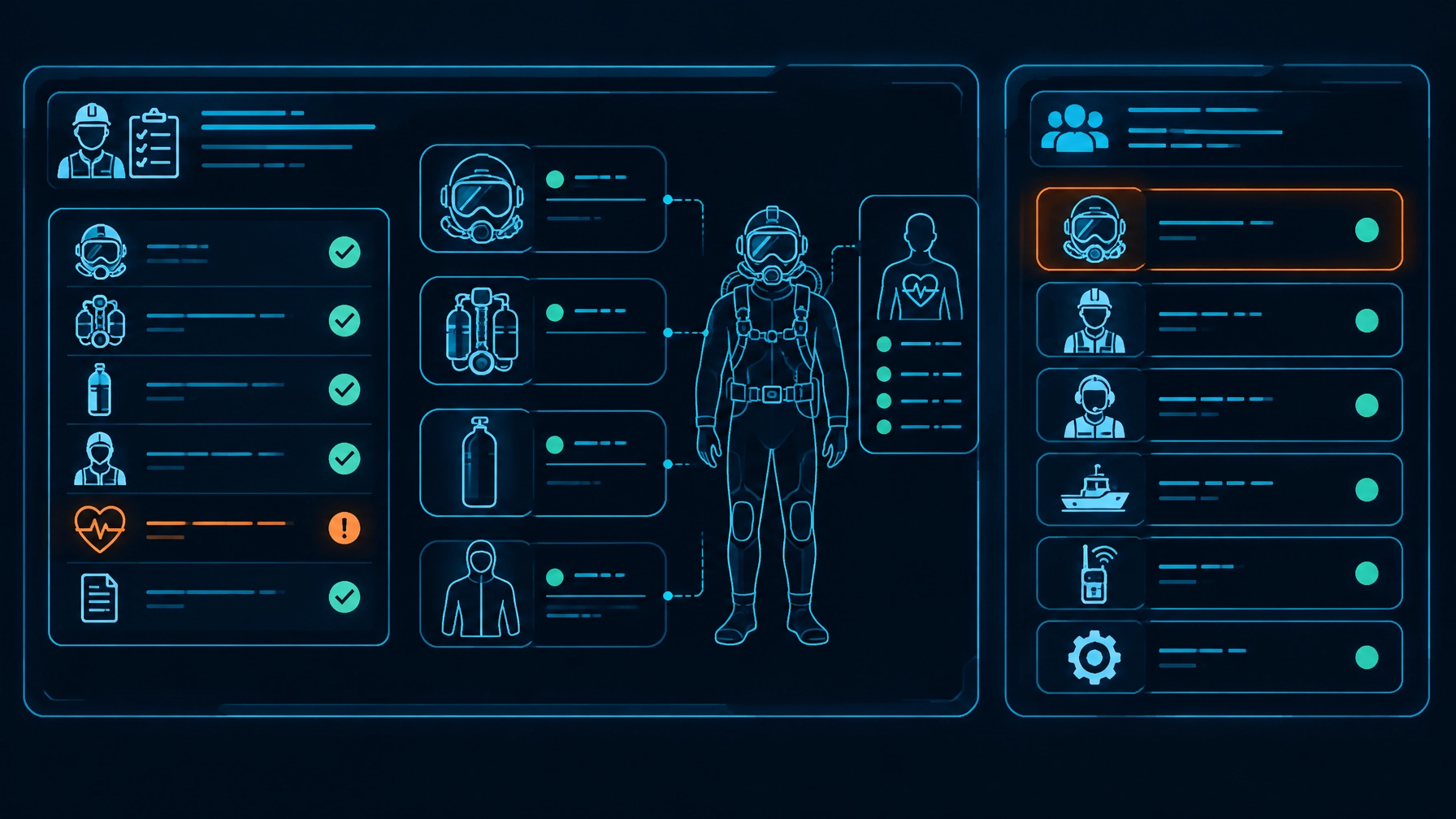
Under amended §6052(c)(1)(C)3, the designated person-in-charge (DPIC) must ascertain that each diver has conducted a functional check of their own diving equipment. The check includes relevant equipment and systems such as breathing-gas supply and reserve gas, masks or helmets, thermal protection, and bell-handling mechanisms when applicable. The DPIC must also inquire into the diver’s current state of diving fitness.
This DPIC duty is not new — the 2024 version already required it — but the amended text is the reference point your procedure should match. It does not make the DPIC responsible for performing every equipment check. It makes the DPIC responsible for verifying that the diver completed the check and for asking about current fitness.
Update your process:
- Add an individual equipment-check confirmation for each diver.
- Record that the DPIC made the fitness inquiry.
- Include the verification in the pre-dive briefing or sign-off process.
- Establish how a concern is handled before the diver enters the water.
A generic “equipment checked” box may not capture who completed the check or whether the DPIC made the required inquiry. Align the checklist with the actual duty in §6052(c)(1)(C)3.
2. Apply the SCUBA depth and chamber thresholds precisely
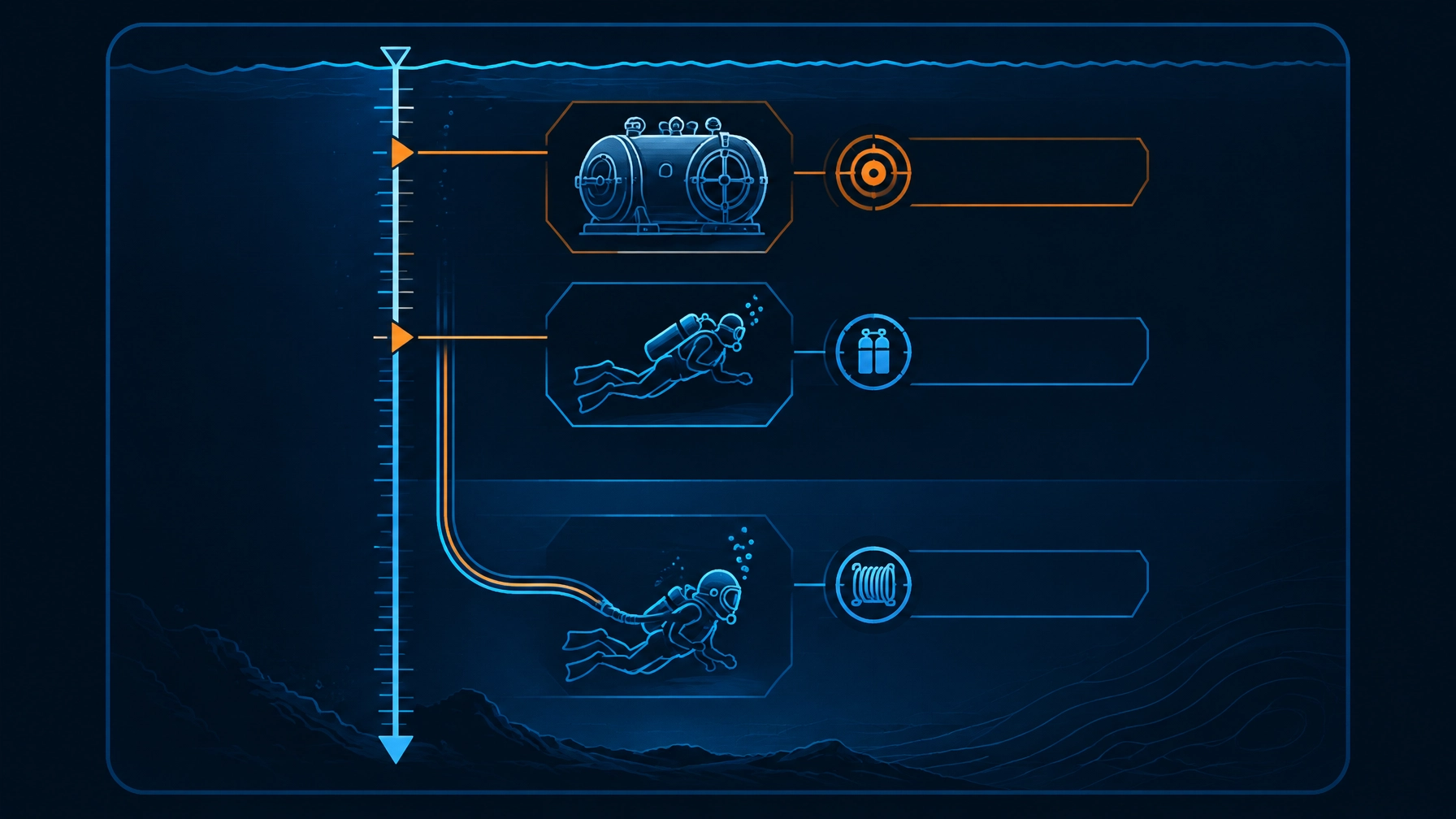
Amended §6056(a)(1) sets a firm SCUBA limit of 130 fsw (40 msw). It also requires a decompression chamber to be ready for use for SCUBA dives deeper than 100 fsw (30 msw) or dives outside no-decompression limits.
The distinction matters: the chamber trigger is deeper than 100 fsw, not simply “at 100 fsw and beyond.” Use the exact regulatory language when writing plans and procedures.
The 130-fsw SCUBA limit aligns with the federal limit in 29 CFR 1910.424. California’s amended text does not create a general technical-diving exception allowing commercial SCUBA beyond that cap. The former definition of “Technical Diving” was repealed from §6051; do not rely on a technical-diving label as authorization to exceed the SCUBA limit.
Surface-supplied air is a separate diving mode with its own provisions in §6056(b). Do not apply the SCUBA limit as if it were the surface-supplied limit, or assume that surface-supplied operations are exempt from their own depth, chamber, and procedural requirements. Review the applicable mode-specific rule for each plan.
Update your plan and logistics checks: identify the diving mode, confirm the planned depth, and document chamber readiness whenever the rule requires it. A chamber alert or planning tool can support that review, but the DPIC must verify that the actual operational arrangements meet the requirement.
3. Recheck standby coverage, zoo and aquarium exceptions, and hookah procedures
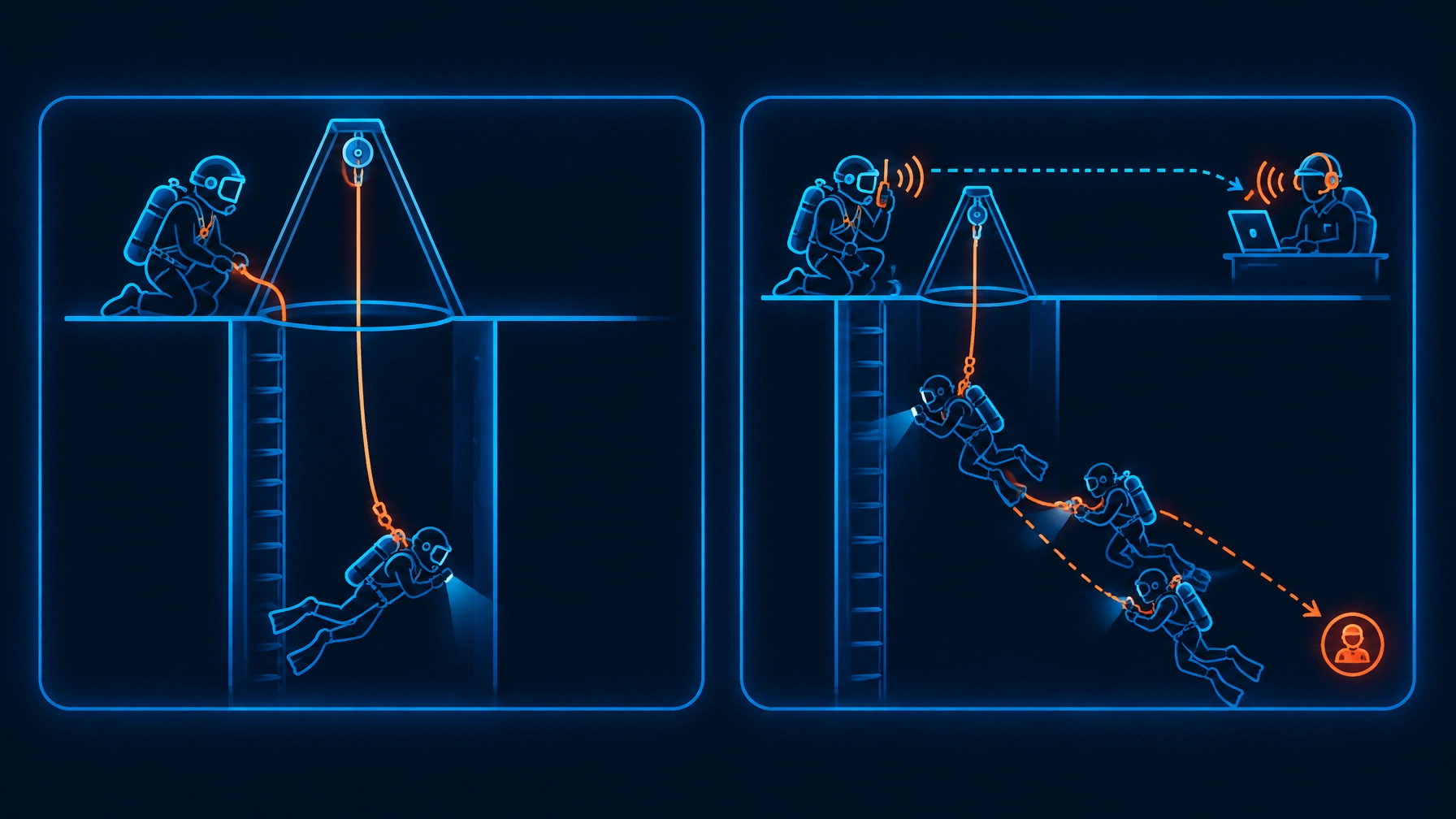
Under §6056(a)(2), a standby diver must be available while a SCUBA diver is in the water. The regulation provides a specific exception for zoo and aquarium exhibit diving. In that context, the employer must meet one of the specified alternatives, and the DPIC cannot have other responsibilities that could interfere with responding to an emergency, line-tending, or serving as standby diver.
That is a limited exception, not a general waiver for commercial work or film and television operations.
Hookah diving is also restricted. Under §6056(a)(5), it is permitted only for zoo and aquarium exhibit diving and film and TV diving, and it may not exceed 30 fsw (9 msw). Hookah divers must be hose-tended by a separate dive-team member.
For film and TV diving in a controlled environment, the regulation provides a narrow exception to specified hookah harness and independent-reserve-gas requirements. It requires a trained in-water support diver with no other duties for each diver using the exception. A 1:1 ratio, and an in-water competent person who is trained and available to respond to an emergency.
Update staffing and documentation:
- Name the standby diver and confirm availability before the dive.
- Document any applicable zoo or aquarium exception and the DPIC’s assigned duties.
- For permitted hookah operations, record the mode, depth, hose tender, and any qualifying support-diver assignments.
- Do not extend a film/TV or exhibit-diving exception to a different operation type.
4. Treat “controlled environment” as a narrow Film and TV definition
Amended §6051 defines “Controlled Environment” for Film and TV Diving only. The defined space must allow ready communication between divers and the surface, prevent external hazards from entering, and effectively control hazards within the space. A dive team trained and ready to respond to the space’s specific hazards must be present and available.
The definition includes minimum training elements such as surveying the space, safety briefings, rescue diving, and underwater communication. The regulation also defines Film and TV Diving; it excludes work that is integral to an ongoing construction, demolition, or maintenance job.
Do not treat “controlled environment” as a broadly available contractor exemption. In particular, confined-space and current-related exceptions have conditions that must be read directly in §6056. The rule also contains specific entry-point and support requirements; apply the provision for the diving mode and operation at hand.
5. Bring manuals, plans, and records into alignment
The amendments are a prompt to review the documents crews actually use, not just the regulation binder. §6052 requires an employer-maintained Manual for Diving Safety available to each dive-team member at the dive location. §6055 covers dive planning, and §6054 addresses the manual’s content.
Review these materials together:
- Manual and written procedures: Update pre-dive verification, staffing, mode-specific limits, chamber readiness, and any narrowly applicable exception procedures.
- Dive plans: Make the diving mode, depth, gas arrangements, team assignments, hazards, and emergency procedures clear.
- Training records: Preserve evidence that team members are trained for assigned duties, especially when an operation relies on film/TV controlled-environment provisions.
- Compliance paperwork: Ensure sign-offs and records reflect what was checked, who was assigned, and which rule or exception supports the plan.
A completed form is useful only if it reflects the operation as conducted. Supervisors should confirm the plan, equipment, personnel, and emergency resources are consistent before authorizing the dive.
A practical implementation check
For each California operation, ask:
- Does §6050 cover this job, and do the commercial-diving provisions in §§6059–6063 also apply?
- Has the DPIC verified each diver’s own functional equipment check and asked about current fitness?
- Is the plan correctly classified as SCUBA, surface-supplied air, or another applicable mode?
- For SCUBA, does it stay within 130 fsw, and is a chamber ready when required?
- Are standby, tender, and support roles assigned without relying on an exception that does not apply?
- Do the Manual for Diving Safety, plan, briefing, and records match the amended requirements?
Tools can support the process, not replace it
For contractors who want to organize plans and paperwork, NavCommand is built for commercial diving operations using U.S. Navy Rev 7 tables and workflows associated with ADCI and federal OSHA requirements. It includes team dive plans, real-time diver tracking, sign-off lines, chamber alerts, and paperwork generation. It is a planning and documentation aid; it does not replace California-specific regulatory review, the employer’s safety manual, or qualified supervisory judgment.
Public safety teams can review IncCommand, which includes OSHA 1910.424 SCUBA-limit checks. Applicability of the public-safety provisions depends on the operation and employer; confirm coverage rather than assuming an exemption.
The California amendments became effective January 1, 2026. If your procedures have not been checked against the final text, review them now. Start with the OAL-approved amendment, the current Title 8 diving regulations, and federal 29 CFR 1910 Subpart T. For decisions about coverage or interpretation, consult your safety officer, qualified compliance professional, or counsel.