A second dive does not start with a blank slate. In the U.S. Navy Diving Manual, Revision 7, Change A, the repetitive group from the previous dive and the surface interval determine how much residual nitrogen time must be carried into the next plan.
Table 9-8 connects those details. It converts the previous repetitive group and the surface interval into a new group and a residual nitrogen time (RNT). That RNT is then added to the actual bottom time of the next dive to produce the equivalent single dive time (ESDT).
This guide explains that sequence. It is an educational walkthrough, not a dive plan or a substitute for the complete manual, training, qualified supervision, or your organization’s procedures.
For context on the chapter, see Navy Dive Tables 101. For the preceding Table 9-7 walkthrough, read How to Read Navy Table 9-7.
Why the group letter matters
Table 9-7 assigns a repetitive group designator after each dive, including a no-decompression dive. That letter is part of the Navy table procedure for tracking residual nitrogen between dives.
For a repetitive dive, you need both:
- The group letter from the previous dive.
- The surface interval before the next dive.
Table 9-8 uses those inputs to determine the diver’s new group at the end of the interval. That group is then used to find the RNT for the planned depth of the repetitive dive.
The group letter is not a stand-alone no-decompression limit, and it is not interchangeable with an individual tissue reading from another dive-planning method. It is a table entry to carry forward as directed by the manual.
Table 9-8: follow the lookup path
Table 9-8 is titled “Residual Nitrogen Time Table for Repetitive Air Dives.” Its instructions describe a specific route through the table:
- Locate the previous-dive repetitive group along the diagonal line above the table.
- Read horizontally to the interval containing the diver’s surface interval.
- Read vertically downward to the new repetitive group designation.
- Continue downward in that same column to the row for the planned repetitive-dive depth.
- Read the value at the intersection. That is the RNT, in minutes, for the repetitive dive.
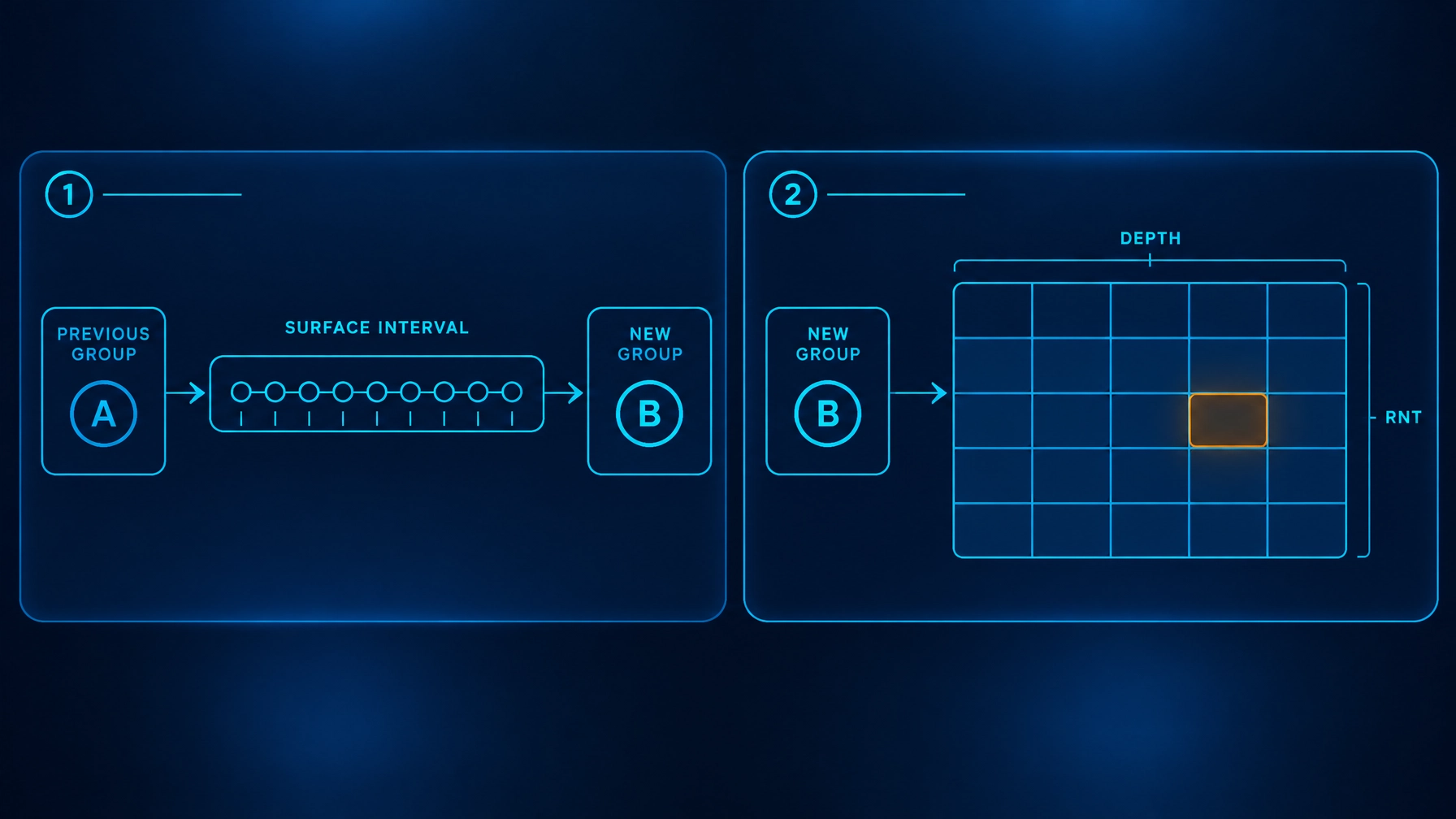
The surface-interval entries are shown in hours and minutes. Depending on the layout, an entry may show paired values for successive group changes. Use the table’s horizontal and vertical reading path to identify the group that applies; don’t treat an interval value as the RNT.
Depth and time entries require the same conservative reading habits covered in the previous article: follow the manual’s instructions, and do not round a depth or time down to a more favorable entry. If you are unsure which cell or group applies, stop and verify the lookup against the complete manual.
Carry RNT into the next dive
Once Table 9-8 gives the RNT for the repetitive-dive depth, add it to the actual bottom time planned for that dive:
RNT + actual bottom time = equivalent single dive time (ESDT)
Use that ESDT with the appropriate depth row in Table 9-9, the Air Decompression Table. Table 9-9 is the next step for determining the applicable air decompression schedule. If assessing a no-decompression repetitive dive, compare the ESDT with the applicable no-decompression limit in Table 9-7, following the manual’s procedures.
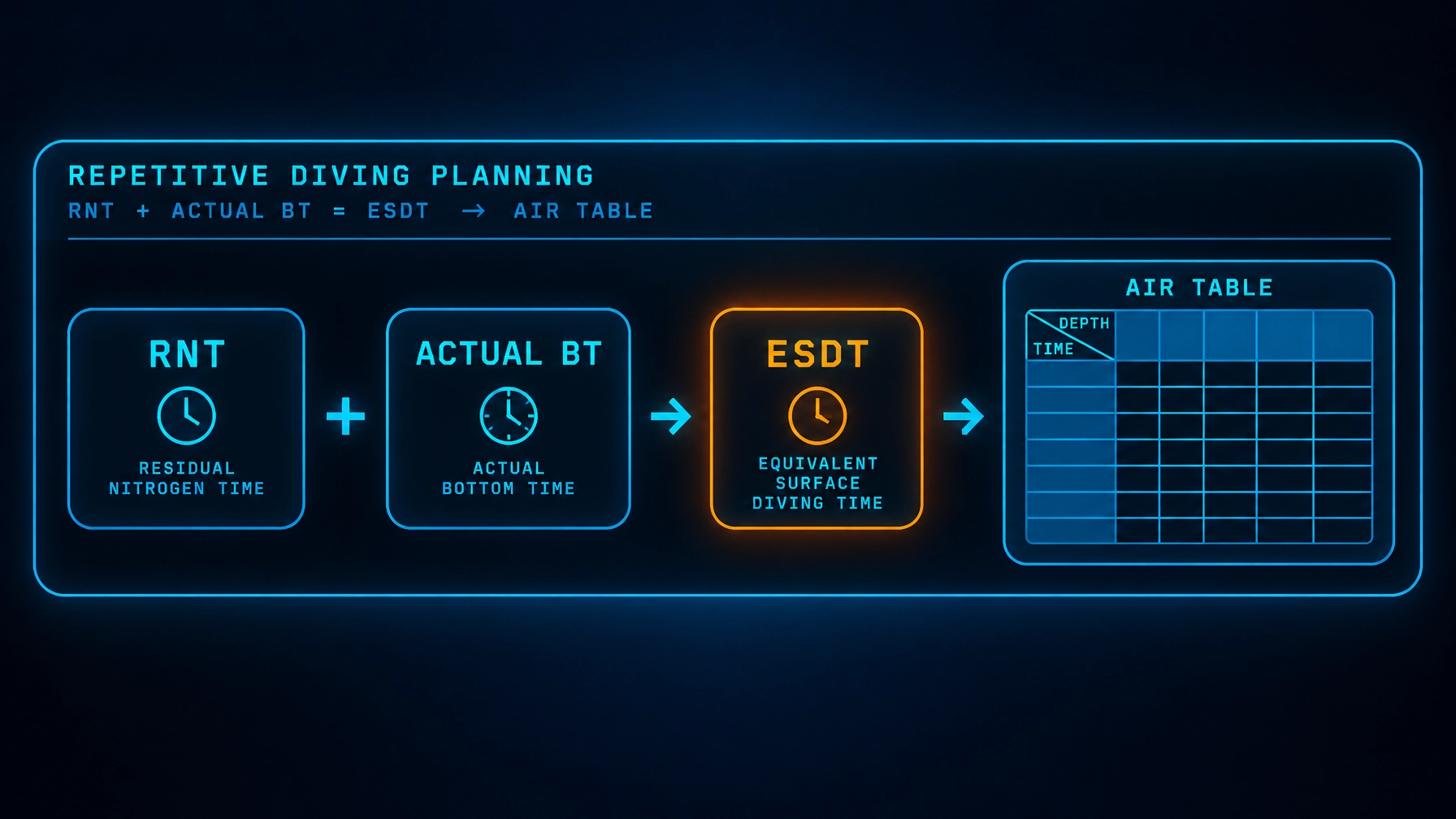
The RNT represents time attributed to nitrogen remaining from the earlier dive. ESDT combines that carried-forward time with the planned dive time so the table procedure can account for the repetitive exposure. It is not the same as simply adding the two dives’ clock times or using the next dive’s actual bottom time alone.
A worked-example pattern
In the previous article, a diver made a 60-fsw dive for 40 minutes. Using Table 9-7, that profile results in Group H.
For the next dive:
- Carry Group H forward as the previous-dive group.
- Use the actual surface interval in Table 9-8 to find the new group at the end of that interval.
- In that same group column, read the RNT at the depth planned for the second dive.
- Add that RNT to the second dive’s actual bottom time to calculate ESDT.
- Use the result with Table 9-9, or compare it with the appropriate Table 9-7 no-decompression limit when checking a no-decompression repetitive dive.
The exact new group and RNT depend on the actual interval and second-dive depth. Read those values directly from Table 9-8 in the official manual; this example does not assign invented values to an unspecified interval or profile.
Know when a dive is no longer repetitive
Table 9-8 marks certain surface-interval entries with an asterisk. The manual’s footnote states that dives following surface intervals longer than the starred value are not repetitive dives. For those dives, use the actual bottom time in the Air Decompression Tables to compute decompression, rather than applying the repetitive-dive RNT procedure.
This is a distinct rule, not a reason to skip the rest of the manual’s planning requirements. Check the correct asterisked value for the previous group and follow the corresponding instructions. Do not assume every long interval has the same cutoff.
Common Table 9-8 mistakes
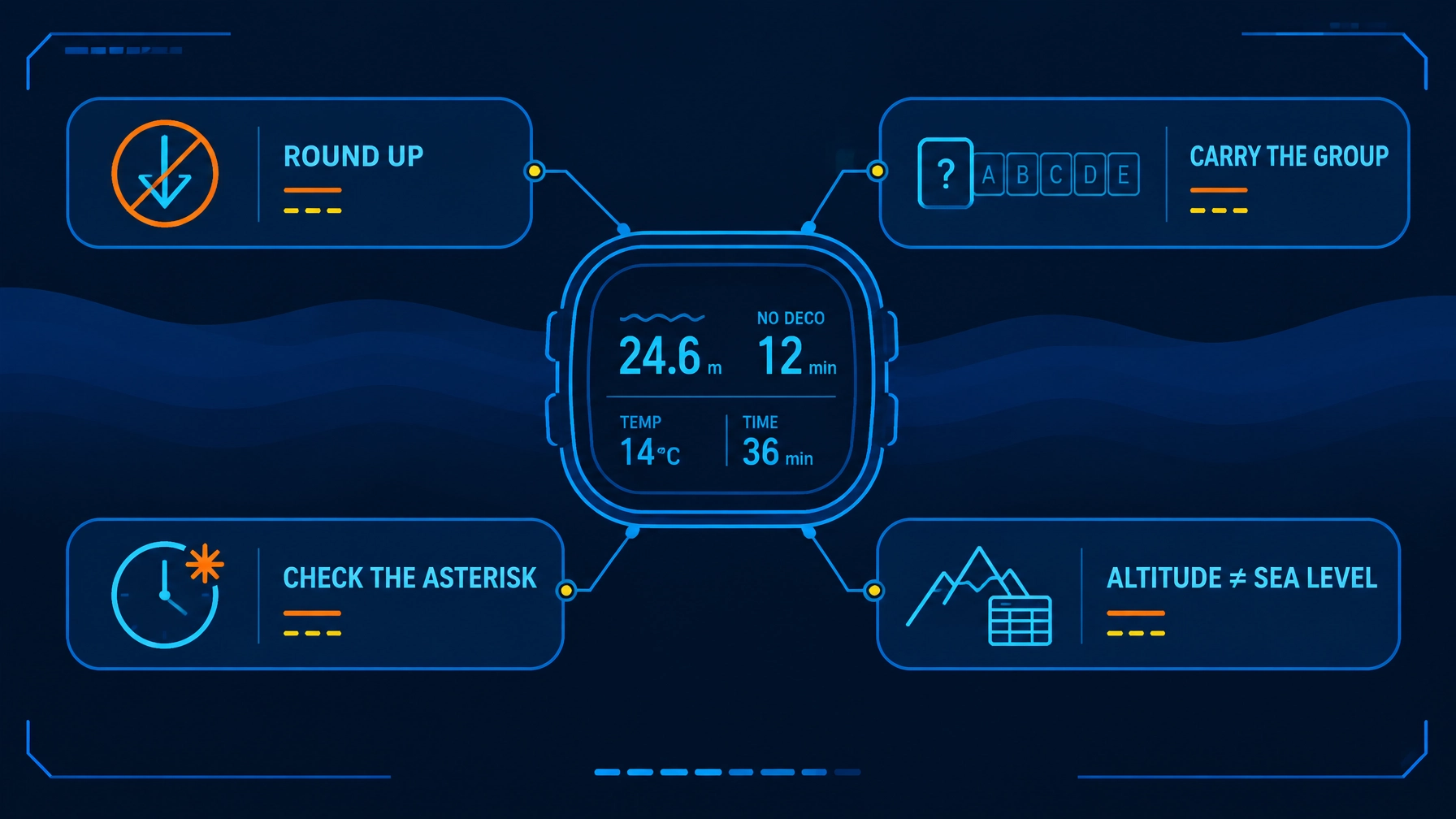
- Rounding down. Selecting a shallower depth or shorter time than the entry calls for can understate the table values. Follow the manual’s conservative selection instructions.
- Dropping the group letter. Table 9-8 needs the previous dive’s group and the surface interval. Record the group after every dive.
- Reading the wrong part of the table. Surface-interval entries determine the new group. RNT is read afterward, at the repetitive-dive depth, in the correct group column.
- Treating every later dive as repetitive. Check the asterisked surface-interval limit. Beyond it, the manual says the dive is not repetitive.
- Applying sea-level tables at altitude. Tables 9-7 and 9-9 are sea-level air tables. Altitude procedures are elsewhere in Chapter 9; use the applicable procedure in the manual rather than applying sea-level entries unadjusted.
- Mixing planning methods. Navy Rev 7 tables and Bühlmann-based planners use different methods. Do not combine their outputs as though they were interchangeable.
The manual specifies a 75-fpm descent rate and a 30-fpm ascent rate for the Chapter 9 air tables. Those rates do not replace the complete profile, table notes, or operational procedures.
Use the official source and the right limits
Consult the official NAVSEA Diving Publications page for the U.S. Navy Diving Manual, Revision 7, Change A, Volume 2, Chapter 9, “Air Decompression.” The printable Table 9-7 card can help with study, but it is a quick reference for Table 9-7-not a substitute for Table 9-8, Table 9-9, or the complete manual.
For commercial diving, follow the regulations and procedures applicable to the operation. OSHA’s 29 CFR 1910.424 addresses SCUBA diving operations, including a 130-fsw limit in the covered context. A depth listed in a Navy table does not override a regulatory limit or authorize a particular dive.
Digital tools can help apply a defined procedure consistently. NavCommand runs USN Rev 7 tables digitally for commercial operations. It does not replace the manual, diver training, or qualified supervision.
Next in the series: Table 9-9
The core repetitive-dive sequence is straightforward: carry the previous group, account for the surface interval in Table 9-8, read the RNT for the next depth, and add it to actual bottom time to get ESDT. The next post in this series will focus on reading Table 9-9 and following its decompression schedule.
Until then, verify every entry against the official manual and the procedures governing your dive.